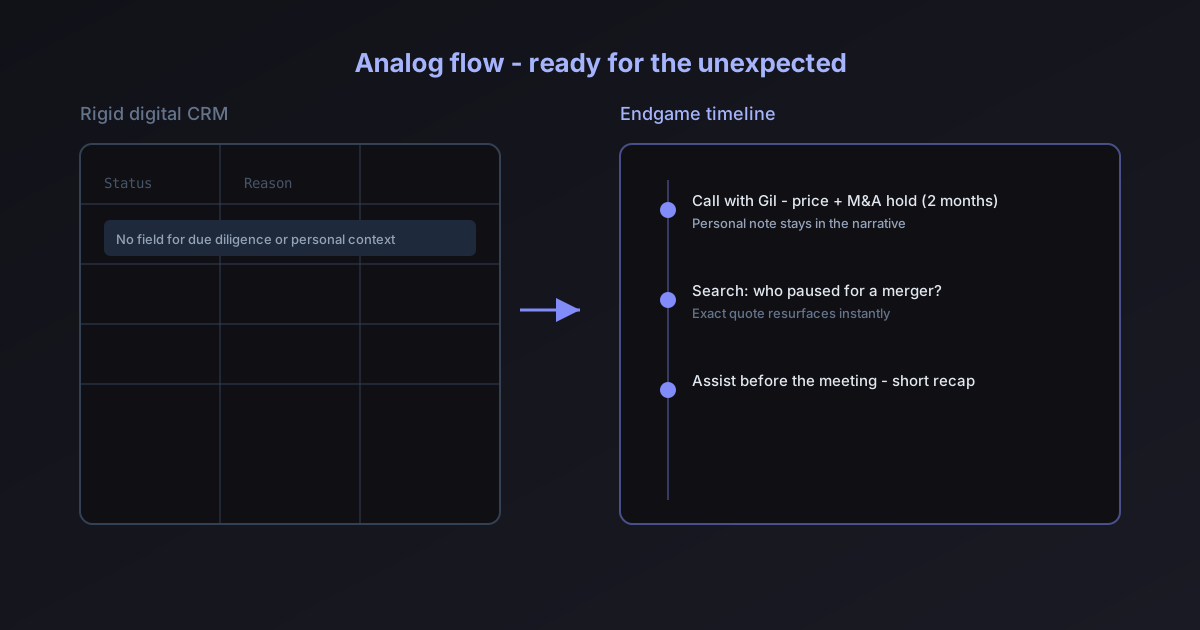
1. Reality is analog: "expected" vs. "unexpected"
Traditional CRM systems were built on a flawed assumption: that life and customer interactions are digital—easy to pre-split into drawers, categories, and dropdowns.
But life is analog. Human thought is a stream, communication is narrative, and time is a chronological Timeline moving forward.
- In an "expected" reality (schemas and tables): When everything follows a known script—the customer calls, asks for package B, signs, and moves to the next stage—a rigid digital table works fine.
- In the real, high-stakes "unexpected" reality: True deals and meaningful relationships often form where you did not plan ahead. A customer mentions an sudden org change in passing, raises a non-standard concern, shares something personal, or proposes a deal structure that does not exist in any dropdown.
That is where mechanical CRM breaks—and Endgame CRM shines: When something unexpected happens, mechanical CRM forces you to interrupt your train of thought, re-engineer the information, or skip documenting it. In Endgame CRM, free text and an analog Timeline hold every insight, shift, or surprise exactly as it happened—with no friction.
2. Field examples: what this looks like in practice
Example 1: The unexpected in a sales call
- What actually happened (the analog story):
*"I sat with Gil. Mid-conversation on pricing he mentioned they are evaluating an acquisition of a competitor, so he cannot commit to an annual license until their due diligence closes in about two months. He also noted his daughter starts university in Haifa next week so he will be mostly offline."*
- In a digital, mechanical CRM (stuck in "expected"): There is no field for "competitor acquisition due diligence" and no dropdown for "daughter moving cities." The rep sets status to
Frozen, picks a generic reason, and the most critical context disappears. - In Endgame CRM (ready for "unexpected"): You write the paragraph as-is on the Timeline. Two months later, ask the journal: *"Who was on hold because of a merger?"*—and the exact quote comes back.
Example 2: Classic field filters vs. natural prompts in Endgame CRM
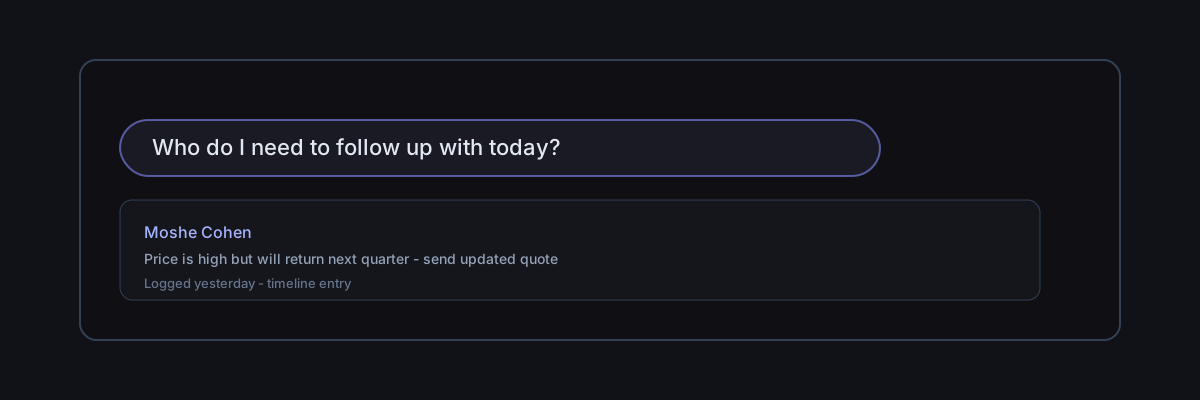
How do you pull information day to day? In Endgame CRM you do not craft complex commands—you run a short, natural question, like in conversation:
Scenario A: Nuance on pricing
- Classic CRM:
Filter: [Deal Status = Lost] AND [Reason Dropdown = Price]*(you get a dry list of names).* - Endgame CRM:
*"Who said price was high but would come back next quarter?"*
Scenario B: Daily commitment tracking
- Classic CRM:
Filter: [Task Type = Follow-up] AND [Due Date = Today]*(shows "call Moshe" without what was promised).* - Endgame CRM:
*"Who do I need to follow up with today?"*
Scenario C: Retrieving an unexpected detail
- Classic CRM:
Filter: [Industry = Tech] AND [Custom_Field_Cloud = Chinese]*(if the field was never defined—the information is lost).* - Endgame CRM:
*"Who works with a cloud provider from China?"*
3. Comparison: digital/rigid vs. analog/continuous
| Dimension | Traditional CRM (schemas & tables) | Endgame CRM (Timeline & free text) |
|---|---|---|
| Worldview | Discrete digital: forms, fields, dropdowns | Analog & continuous: chronological journal |
| Handling surprise | Fails or interrupts work (no matching field) | Strong: write naturally with no friction |
| Input experience | 1.5–2 hours/day "feeding the matrix" | ~10 minutes/day of natural notes |
| Search | Rigid filters on predefined fields | Short natural questions ("who said…?") |
| AI | Pushy auto-suggestions | Manual Assist—a second pair of eyes when you ask |
4. How this fits daily workflow
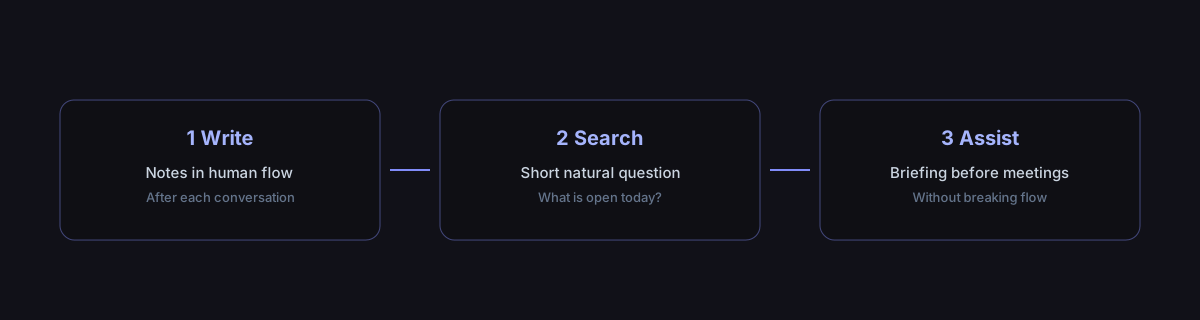
- During the day — write naturally (Write): After a conversation, add a short continuous paragraph to the customer journal. No forms, no dropdowns, no stops.
- Start of day — ask in your language (Search): Morning review is not a maze of filters. Ask: *"What is open for today?"* and get direct answers with the original quotes you wrote.
- Before a meeting — context on demand (Assist): Need the full story with a customer? Run Assist for a concise recap of the narrative built over time.
5. Who it is for — and who less so
A strong fit for:
- Operators, founders, and customer leaders: People living in complex, shifting reality where human context and unexpected details win deals.
- Consultants, lawyers, and agencies: Client work with narrative complexity and detail-rich conversations.
- Small, sharp teams: Shared, trustworthy organizational memory without CRM fatigue.
Less suited for:
- Mass dialing / high-volume telemarketing: Hundreds of leads per day moved robotically between dry statuses only.
- Culture of rigid tabular reporting: Companies mandating analytics across many required fields for managers—at the expense of field workflow.
Summary: Life is not a spreadsheet—your CRM should not be either
Deals close in life's analog sequence—in small details, unexpected turns, and stories built over time. When you stop forcing your thinking into rigid tables and use a continuous Timeline, you reclaim focus, time, and the ability to lead.